
Details hidden in a PDF
A buyer looks for precision turned parts in small batches. Your tolerances are only in a catalog PDF that hardly gets found.
Before requests go out, there is often a list of possible suppliers, more and more often built with ChatGPT and Google. We measure for which questions your company gets named and make your technical details readable for people and machines.
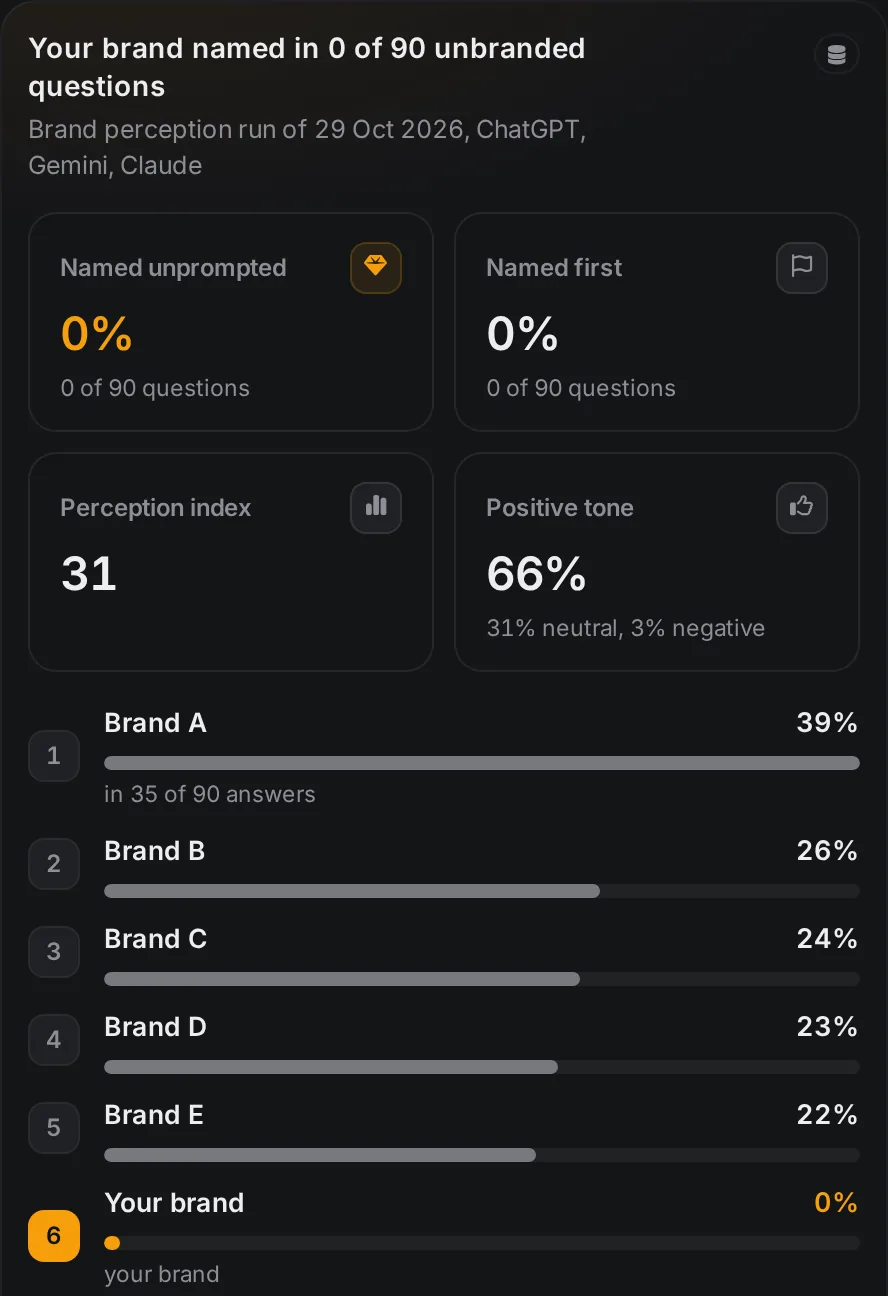
For precision turned parts in small batches, these are often named:
Your company makes exactly that, but is not named.
If you are not on the list, nobody asks.
In plain wordsAI names suppliers whose details it can find and understand: which processes, materials, tolerances, certifications, quantities. If that only sits in a scanned catalog, AI does not see it.
A buyer looks for precision turned parts in small batches. Your tolerances are only in a catalog PDF that hardly gets found.

AI is supposed to find a company with a specific certification. It is only mentioned in a scanned document.

A purchasing team builds a list of possible suppliers before requesting quotes. Whoever is missing there does not get asked.
Our own measurements and studies, with sources. Where a number applies to all industries, we say so.
For questions about providers, AI almost always names names. The only open question is whether yours is among them. In our data test, a citation was most strongly linked to whether a page answers the question directly.
Sources: The industry value comes from our AI click calculator, our own analyses of around 300 websites, mostly from Austria, as of October 2026. The other values apply to all industries: 85% and 35% from our provider analysis with 873 searches in four AI services, October 2026. 2.48x from our data test with 522 searches, a correlation, not proof. −40% from our AI Mode study, summer 2025 vs summer 2026. Provider analysis · GEO data test · AI Mode study · AI click calculator
Not every question ends with a recommendation. When someone asks for providers, ChatGPT almost always names names, for knowledge questions rarely. The first two rows matter most for you.
| Aspect | Example from your industry | ChatGPT names providers |
|---|---|---|
| Provider search | "which provider has the best temporary halls?" | 85% |
| Price question | "what does a 500 sqm hall cost" | 55% |
| Comparison | "hall construction wood or steel" | 39% |
| Knowledge question | "do you need a building permit for a tent hall" | 22% |
Source of percentages: our provider analysis with 873 searches, October 2026, all industries. The example questions come from our analyses and show how users in this industry ask, translated from German.
From our analyses: this is how buyers ask when they look for offers like yours, translated from German. Next to them: what your website needs for them.
Source: our own analyses of search queries, mostly from Austria, June 2025 to October 2026. Only questions that came up several times independently, without company, brand or personal names.
Four steps, each with a result you can see.
Which questions do buyers ask AI? From search data, customer voices and your expertise.
Result: question list by priority

Each question several times in ChatGPT, Perplexity, Gemini and Google AI, without questions containing your name.
Result: baseline per question and system
Pages that answer the questions directly, with clear details: processes, materials, tolerances, certifications and capacity.
Result: pages that can be cited

Measure the same questions again regularly and see what changes.
Result: a trend, not a snapshot
The more specialized the offer, the more important it is that AI places it correctly.
Questions about process, material and quantity, often limited by region.
Questions about application, performance and service.
Questions about field, standards and experience.
Questions where quality or environmental certificates decide.
The platform shows how ChatGPT, Gemini and Claude describe your brand, which providers get named instead of you and where you can catch up fastest.
Measure first, then act.
In the first call we ask a few typical supplier questions live and show who gets named today. Free, no obligation, 30 minutes.
Your contact: Aredi Dragusha, [email protected]