

Knowledge spread across pages
A university lists requirements and degree only across several subpages. AI finds that hard to compare.
Which training fits next to the job, which university offers the subject part time? Questions like that often go to ChatGPT today. We measure whether your offer gets named and make content, duration, costs and degree clearly readable.
For part time project management in Vienna, these are often named:
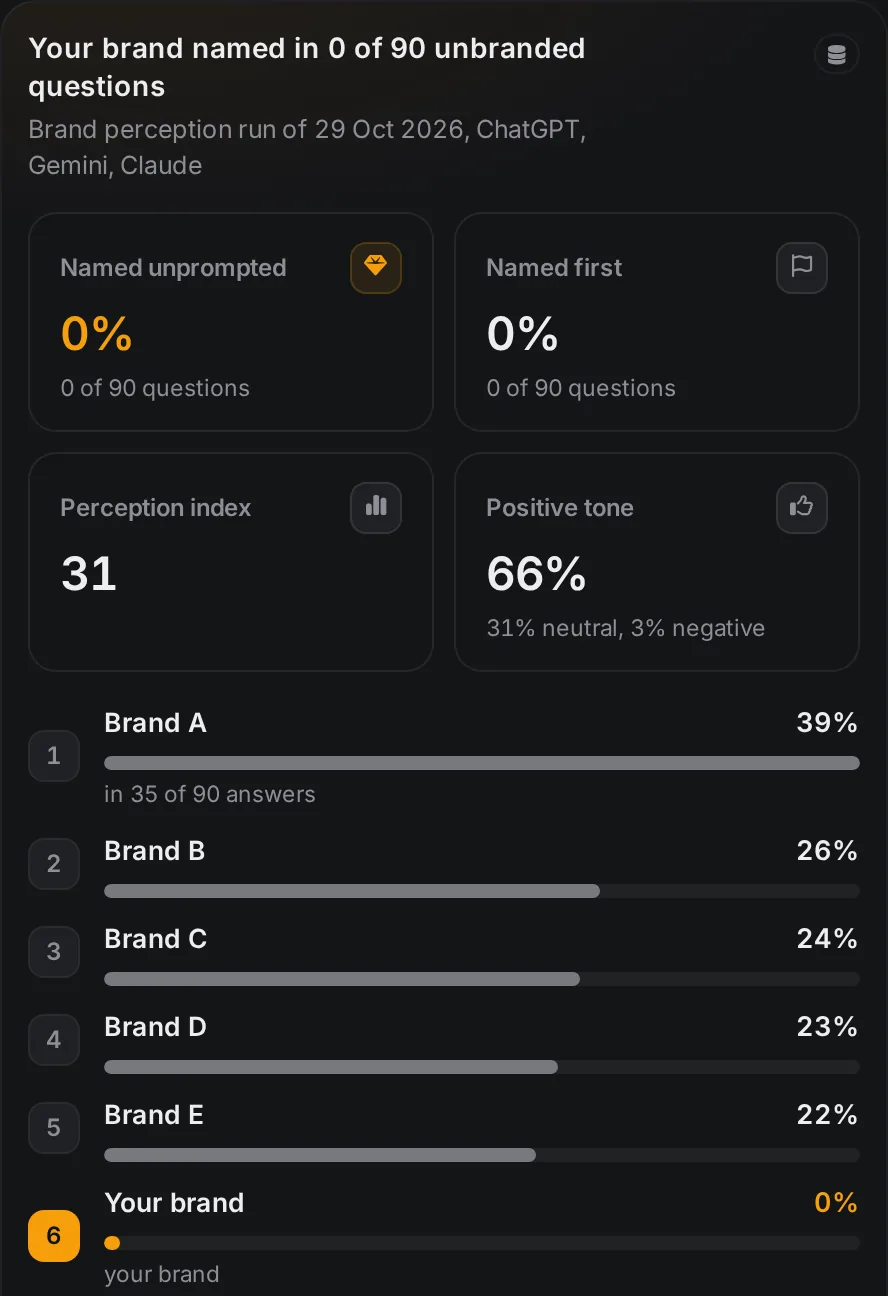
Your program fits exactly, but is not named.
A good course deserves a clear answer.
In plain wordsAI names offers it can describe clearly: for whom, how long, what it costs, which degree, which requirements. If that is spread across many pages or missing, it prefers to name platforms and big providers.
A university lists requirements and degree only across several subpages. AI finds that hard to compare.

A course lacks learning goals or duration. People can hardly judge whether it fits their goal.

Someone asks for a part time course and gets offers named that explain their criteria clearly. Whoever does not stays out.
Our own measurements and studies, with sources. Where a number applies to all industries, we say so.
For questions about providers, AI almost always names names. The only open question is whether yours is among them. In our data test, a citation was most strongly linked to whether a page answers the question directly.
Sources: All values apply to all industries: 85% and 35% from our provider analysis with 873 searches in four AI services, October 2026. 2.48x from our data test with 522 searches, a correlation, not proof. −40% from our AI Mode study, summer 2025 vs summer 2026. Provider analysis · GEO data test · AI Mode study
Not every question ends with a recommendation. When someone asks for providers, ChatGPT almost always names names, for knowledge questions rarely. The first two rows matter most for you.
| Aspect | Example from your industry | ChatGPT names providers |
|---|---|---|
| Provider search | "courses in vienna" | 85% |
| Price question | "cost of catching up on the school leaving exam" | 55% |
| Comparison | "university vs university of applied sciences salary" | 39% |
| Knowledge question | "how does an apprenticeship with school leaving exam work" | 22% |
Source of percentages: our provider analysis with 873 searches, October 2026, all industries. The example questions come from our analyses and show how users in this industry ask, translated from German.
From our analyses: this is how learners ask when they look for offers like yours, translated from German. Next to them: what your website needs for them.
Source: our own analyses of search queries, mostly from Austria, June 2025 to October 2026. Only questions that came up several times independently, without company, brand or personal names.
Four steps, each with a result you can see.
Which questions do learners ask AI? From search data, customer voices and your expertise.
Result: question list by priority

Each question several times in ChatGPT, Perplexity, Gemini and Google AI, without questions containing your name.
Result: baseline per question and system
Pages that answer the questions directly, with clear details: content, duration, costs, degree, requirements and dates.
Result: pages that can be cited
Measure the same questions again regularly and see what changes.
Result: a trend, not a snapshot
University, academy or online course: the questions differ. We measure the ones that fit your offer.
Questions about part time courses, certificates and funding.
Questions about programs, admission and study format.
Questions about format, price and degree.
Questions about topic, trainer and date.
The platform shows how ChatGPT, Gemini and Claude describe your brand, which providers get named instead of you and where you can catch up fastest.
Measure first, then act.
In the first call we ask a few typical learner questions live and show who gets named today. Free, no obligation, 30 minutes.
Your contact: Aredi Dragusha, [email protected]